
On view
American, 1907–2002
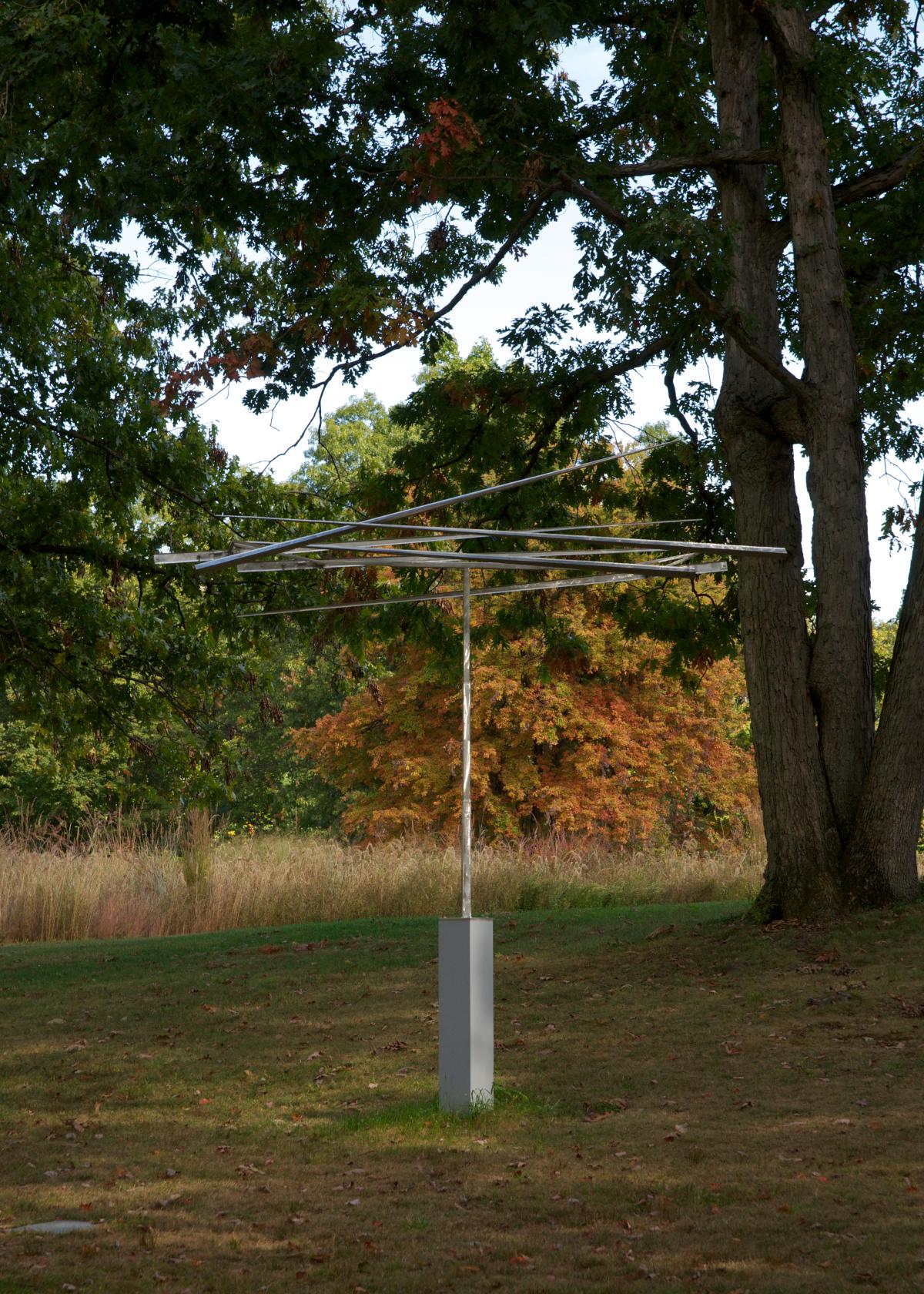
Six Lines in a T, 1966–79
Stainless steel
10 ft. 8 in. x 6 ft. 6 1/2 in. x 30 1/2 in. (325.1 x 199.4 x 77.5 cm)
Gift of the Ralph E. Ogden Foundation
© 2021 Estate of George Rickey / Licensed by VAGA at Artists Rights Society (ARS), NY
Photo by Jerry L. Thompson
George Rickey is best known for what he called his “useless machines.” Carefully crafted kinetic sculptures made of reflective stainless steel, these graceful, precisely calibrated artworks move organically at unpredictable intervals, calling attention to the effects of wind, light, and the changing surroundings. The sculptures are sited in a glade, as Rickey’s works are not intended for the strong gusts of open spaces.
Born in South Bend, Indiana, in 1907, Rickey was the son of an engineer with a degree from the Massachusetts Institute of Technology and the grandson of a clockmaker. Both encouraged Rickey’s early interest in tinkering, which he largely abandoned to pursue the study of art and to work as a painter. Serving as an engineer in the U.S. Army Air Corps during World War II rekindled Rickey’s childhood engineering experiments, and he made his first simple mobiles at this time. By the late 1940s he had abandoned painting and devoted himself to making kinetic sculpture, an art form that enabled him to join his capacity for making machines with his poetic sensibility.
Six Lines in a T is composed of six handcrafted, reflective, stainless steel blades attached to a thin, horizontal scaffold welded to a slender vertical pole. When at rest, the lines are roughly parallel to the ground. The slightest breeze sets them in motion, each blade moving in its own predetermined arc, crisscrossing the paths of the others without ever touching them. While never creating a sound, the sculpture makes palpable the dynamism of the surrounding atmosphere. Like leaves on a tree, the sculpture’s variegated surface changes with the ambient light.
Born in South Bend, Indiana, in 1907, Rickey was the son of an engineer with a degree from the Massachusetts Institute of Technology and the grandson of a clockmaker. Both encouraged Rickey’s early interest in tinkering, which he largely abandoned to pursue the study of art and to work as a painter. Serving as an engineer in the U.S. Army Air Corps during World War II rekindled Rickey’s childhood engineering experiments, and he made his first simple mobiles at this time. By the late 1940s he had abandoned painting and devoted himself to making kinetic sculpture, an art form that enabled him to join his capacity for making machines with his poetic sensibility.
Six Lines in a T is composed of six handcrafted, reflective, stainless steel blades attached to a thin, horizontal scaffold welded to a slender vertical pole. When at rest, the lines are roughly parallel to the ground. The slightest breeze sets them in motion, each blade moving in its own predetermined arc, crisscrossing the paths of the others without ever touching them. While never creating a sound, the sculpture makes palpable the dynamism of the surrounding atmosphere. Like leaves on a tree, the sculpture’s variegated surface changes with the ambient light.